
In Repair

Just wanted to give you a glimpse of what’s going on in my world.
I’m learning quite a few things about myself during this season.
Like, I really process a lot of things by writing them out (either with pen or keyboard). A lot of what I write, I feel comfortable sharing publicly. Many things I keep in my digital files because they’re too personal (or damning—haha, just kidding. Not really). Obviously, this is the former, not the latter. But I mention this because this is going to be a long one.
So grab a drink and get comfortable.
If you’re reading this while you’re squatting and surfing, I don’t know who’ll finish first: this post or your well-deserved break (hope everything comes out okay).
But if you want the gist—here’s your tl;dr (too long; didn’t read, for the uninitiated):
The Episcopal Church gave me depression.
How’s that for clickbait?
Now… to see how true that statement is… you’re just gonna have to get on this ride with me.
So get your drink and buckle in (unless you’re squatting and surfing… don’t bring your—you know what? You do you. I’m sorry for passing judgment. It’s just that… never mind).
On a bright Sunday morning in August 2024...
tears flooded my eyes as I was driving to church. I had no idea why I was crying.
My son didn’t either. He didn’t say anything about his daddy crying—maybe because he didn’t know what to say—but he tried to keep the conversation going as best he could.
When we pulled into the parking lot, the tears had dried up. I thought everything was back to normal and it was time to go to work.
But as soon as I entered the church, the tears came back with a vengeance.
I went straight to the bathroom, locked the door, and instinctively curled up and just bawled.
When the final sob left me, I looked at my watch. Oh good… there’s still about an hour or so before the first person shows up.
Got up, washed my face, took a deep breath, and headed back out to the world—where I found my son watching a Taylor Swift music video on the church’s TV screens. But he did all the things on the Sunday morning to-do list while I had locked myself in the bathroom.
I didn’t have time to linger in the moment because there were still many things to do before people started to file in.
The liturgy went well.
There were no hitches or hiccups. I didn’t lose it. Whatever took over me was long gone. Or so I thought.
The moment—like seriously, the instant—the hood of my car exited the imaginary boundary of our campus, the tears came back.
This time, my son asked if I was okay and why I was crying. (“Yes… and buddy, I don’t know. I’m sorry.”)
Bless his heart for trying to keep me together.
As soon as I got home, I went straight to the bathroom, resumed the fetal position, and let whatever was within me out.
A workday bookended by fetal positions in bathrooms.
I really should’ve sought help back then.
I assumed it was just the result of a very intense week—and that my body was just catching up to all the emotions.
But that wasn’t the moment that broke me.
Perhaps it was a deep cut—or a fracture.
It didn’t break me.
What else could I do but move forward?
Perhaps (metaphorically speaking, of course) I was moving forward with a limp.
But forward, nevertheless.
If that was it, maybe I would’ve climbed out of the hole I didn’t know I was in.
What did me in was what took place in October and November.
That’s what ended up breaking me.
I’ve been reflecting on 2024.
I described to my Canon to the Ordinary what my year felt like using a boxing analogy.
February was a clean jab to the chin.
June was a straight right I didn’t see coming.
August, a strong left hook.
October, an uppercut.
November, the powerful right hook.
I told the Canon I was up before the 10-count, albeit wobbly.
Turns out, that was a lie. I was out for the count.
But I refused to admit it. I refused to acknowledge it.
I refused to admit that I was hurt; I refused to even entertain the thought that I wasn’t okay.
Of course, I didn’t know I was refusing any of this at the time.
Ah, the gift of hindsight.
I just kept moving forward, not even realizing how numb I was.
These shadows eventually caught up with me.
I wasn’t aware of any of it happening.
I just kept going. And going. And going.
Earlier this month, I had my regularly scheduled one-on-one with my boss.
We were discussing some things we, as Mosaic, should start considering. I felt the excitement building up within me—like, “Oh yeah, if this works, this would be great.”
However, as soon as the call ended, I felt nothing.
It was noticeable enough for me to admit something wasn’t right.
So I called my therapist, and he told me to come see him the very next day.
During our session, I finally shared just how sad I’d been the whole year.
It’s funny. I literally pay this man to talk about my feelings, and yet I reserved a good chunk of them in our sessions.
But that’s because I didn’t want to confront this.
The sadness stemmed from (I thought) my son and our futures.
It really saddened me to the pit to think about how he’d get along without his parents when that time came.
I’ve always been worried about this and thought of it often—but never in a sad way.
I would feel like crying thinking about it—but I wouldn’t allow myself to.
I mean… I was so sad about it, a part of me wanted to pray to God so that I could live to 95 and N live to 65… and he kinda... goes before me. (I felt so ashamed thinking like this, I’m actually surprised I’m leaving this thought in for anyone to see…)
But the source of sadness wasn’t specifically about my son.
There was sadness everywhere.
It permeated into the folds of my life—areas I didn’t even know existed.
The tinge of sadness was everywhere I looked.
That can’t be normal, right?
I told Tom the Therapist all this and he looked at me and said, “Joseph. You might be struggling with depression.”
“Mmm…. Am I? Oooor… am I just the first-born son to Korean parents?”
“Okay, let me ask you some questions.”
True to my Asian form, I aced his pop quiz.
My reward was: yes, indeed, I have depression.
And we hashed back and pinpointed it to February of 2024 where this all began—aka The Jab.
Funny thing… the day before my one-on-one with the boss, I made this video:

Yea. Turns out what was broken inside of me was (is) depression. Tada!
A lot of this stems from never truly processing what happened in October and November—AKA Uppercut and Right Hook, respectively.
I’m learning a lot of new things about myself.
One of them is, apparently, it matters a great deal to me that people see me as someone who keeps going despite The Institution.
Not someone who wins—because nobody wins against The Institution. We go in knowing we’ll take the L, but hoping that the people after us don’t have to.
But someone who takes the L and bounces right back up, like nothing ever happened.
You know, channeling the spirit of Steve Rogers—who, even before becoming Captain America, would take a beating and still get up saying, “I can do this all day.”
Admitting just how hurt I was by The Institution was more than I could face.
It didn’t line up with who I thought I was—or maybe who I wanted to be.
It definitely didn’t align with how I wanted people to see me.
I don’t know why this mattered so much to me.
And I don’t know how long it’s mattered to me.
But I’d rather bury the hurt deep within the bowels of my soul than even acknowledge it.
I couldn’t even muster a ‘Tis but a scratch! (… I usually clarify pop culture references for folks older than me… but I think I have to clarify for those younger than me now…):
Yet, what I thought I thoroughly hid and buried—its ghost haunted me.
But not in the form of vengeance or horror… but in sadness.
Depression.
It was a scary word to hear.
Yet… everything about 2025 started making sense.
I was unbelievably frustrated with myself because I felt like I was being so apathetic; so lazy.
I kept procrastinating—more than usual. It kinda felt like it was getting out of control.
In fact, a lot of things felt out of my control.
I kept chastising myself; trying to will myself to do the things that needed to be done. But it would always take a lot out of me.
Another thing I discovered:
For about two months now, I’d do two-a-days more often than I normally would.
Usually, only Tuesdays would I go to one coffee shop in the AM, take lunch, and go to another coffee shop in the PM (if there were no meetings that day).
But I started doing two-a-days more and more. I’d joke with myself: this will not be sustainable in this economy.
And because my body wasn’t accustomed to that much caffeine, I’d feel weird by early evening.
I’d normally work from home or the church in the afternoons when I didn’t have meetings.
I think this was me avoiding being by myself, which is ironic because as an introvert, I want nothing more than to be “by myself” (sometimes, yes, completely alone; most of the time, by “myself” with my Inner Circle).
Because when I’m by myself… I’m by myself. Alone with my wandering thoughts.
There’s a difference between being alone at a coffee shop (or a public place) and being alone, by yourself. And I didn’t want to be alone, by myself, with my thoughts—because there was a thread to be pulled, and I didn’t want to see what unraveled.
Depression.
Now that I know, there’s a small sense of relief.
Nothing’s wrong with me.
Well… I mean… there are plenty of things wrong with me…
But depression isn’t a definition of who I am—and it’s barely a descriptor.
Since the diagnosis, I’ve been giving myself permission to feel everything and to not hold it in.
It’s been nearly two weeks and:
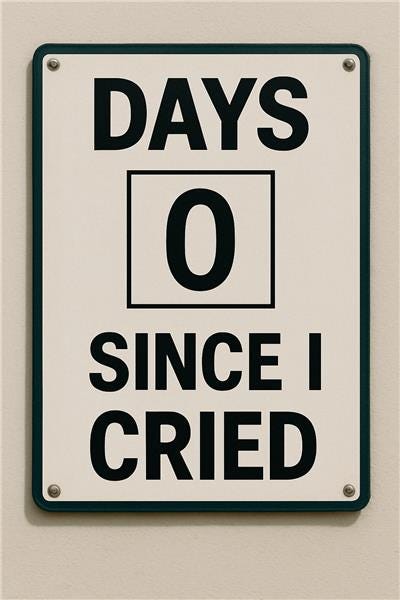
There was a point where I thought to myself—this is ridiculous, I gave myself too much permission.
I was chatting with a friend at my regular coffee shop about non-dairy milks. I’ve been ordering oat milk flat whites for years—figured it was better for my pre-diabetic self and still gave a little sweetness.
Then the barista, who knows I’m pre-diabetic, casually says, “Oh yeah, oat milk is actually the worst option for you.”
First reaction: Why are you telling me this now?!
Second: YOU LIE.
So I googled it.
They were right.
And y’all… I cried. Not a full sob, just one of those quiet waves of sadness.
There I was—literally crying over (not-so-spilled) milk.
That was when I thought, yea... maybe not everything...
The crying has helped me feel a lot better.
The other thing that’s helping me is letting people know what’s going on.
I think my son instantly knew something wasn’t right.
Right after I got my diagnosis, I had to pick him up from school. From the ride home until bedtime, he’d ask, “Daddy, are you okay?” Every 10 or so minutes.
There was a brief moment of hesitation in wanting to tell my wife—part shame, part not wanting to be some sort of additional burden.
But, as expected, she was the easiest person to tell.
She held me, affirmed me that while there may be many things wrong with me, this isn’t one of them, and cried with me.
Humor is how I deal with things.
And I love dark humor, too.
The thing is, you can joke about anything—but you can’t joke about anything with everyone.
Obviously, the wife is someone I can joke about anything with, and vice versa. Laughter has helped restore a bit more color in my life.
I appreciated the jokes that some of my friends responded with:
Have you tried not being sad?
When I shared with one that I’d be on medication:
Mmmm… maybe you should try prayer instead?
(Put that response on the back burner—we’ll come back to it, because I think it’s important.)
And on Easter Sunday, I shared this with my church, tying it into Mary of Magdala’s proclamation of “I have seen the Lord.” (The sermon, if you want to see it and spend even more time with me, will be posted at the end of this post.)
Talking about it has truly helped.
If anything, it’s helped shine a light on the dark spaces in my mind.
This is why I’m sharing this with y’all—and why I shared it with my church.
I also want to do my part to help de-stigmatize mental health issues.
In quoting a modern philosopher and poet:
I might be okay, but I’m not fine at all.
And, seriously… that’s okay.
It’s okay to not be okay. Because once you understand you’re not okay, that’s when the healing process can begin.
I still have a lot of wading through to do.
Oh—and I should mention this: the emotional baggage I’m carrying toward The Institution… it’s not about The Institution anymore. It’s about me.
My head has been in the space of (and has been for a while): it was what it was, and we move forward.
My heart, though, is the one that’s stuck in the “was” part.
And because my head and heart are in two different places—I fell apart.
Now, it’s time to put me back together.
And while I wade through a lot of suppressed muck from 2024, I need everyone to know just how grateful I am for the Episcopal Diocese of Texas. And I always will be. This is no longer about me vs. The Institution. This is about me putting myself together and allowing myself to feel all the things I felt and name all the things I’ve suppressed since February of 2024.
Which brings me to the last thing I want to cover while I share with you (and, remember, I’m a preacher… so don’t reallytrust me—us—when we say “one last thing…” because there could be at least one more thing after the last thing…)
Some of you may be reading this and thinking something along the lines of, “You should just trust Jesus,” or “Instead of taking medication, you should just pray more.”
If that’s you—first off, here’s a big virtual eye roll in your honor and a hearty, “Oh, bless your heart.”
Second—bad theology kills.
“I should just trust in Jesus.”
I stopped seeing my original therapist for various reasons.
By “chance,” I got connected to Tom through a mutual pastor friend—and I’ve found more affinity with Tom than with my previous therapist.
To be more honest: I trust this pastor. He connected me to my current spiritual director, and that’s been a gift.
One day, he shared an Instagram post highlighting Tom and how great of a therapist he is. I felt this nudge—like a holy prompt—to email Tom and get the ball rolling on having someone to talk to. Maybe my spirit knew something even then.
The pastor didn’t steer me wrong with the spiritual director.
And this indirect therapist recommendation turned out just as well.
I choose to believe that prompt to email Tom was something beyond me. (the Spirit if you didn't get my drift).
I don’t know why we (especially American Christians) put so much emphasis on the personal when the emphasis in the Bible is always communal.
The Spirit always leads you to other people.
Following Jesus leads you to others—so that you can help people join the community. Following Jesus leads us to be conjoiners.
Prayer is always accompanied by action.
You pray for a job—but you also go looking for one.
You pray for healing—but you also go to people and places who can offer that healing.
Prayer involves action.
To pray is to act. To act is to pray.
We’ve gotta stop extracting the action part of prayer.
So yes, my seeing a therapist has nothing to do with the level of trust I have in Jesus.
Being prescribed medication has nothing to do with a lack of trust in God or a lack of prayer life. It’s the exact opposite, really.
My trust in Jesus and my prayer life led me to start this journey toward wholeness.
There’ve been plenty of moments where I knew God was with me.
Like the day I filmed that “I’m the problem” video—right after I stopped recording, I heard a rustle in the woods. It was broad daylight, so I checked it out.
Three deer.
And in that moment, I just… felt held.
Or the random voice note I got from a content creator I barely know. We’ve only exchanged a few messages (if that), but their note said, “Just a reminder—you are loved and never alone.”
Then, right after that Zoom call with my boss—when I knew something was off—I got a voicemail from a friend, a local UMC pastor.
He said, “I don’t know why I’m calling, but I felt like I needed to tell you—you’re loved and you’re doing good.”
Coincidence?
Maybe.
But my job is to connect dots—and point to something bigger.
And these dots do point to something bigger.
On the Wednesday of Holy Week, I returned to that same trail with my son, hoping we’d see the deer again.
We did.
He watched them.
I watched him.
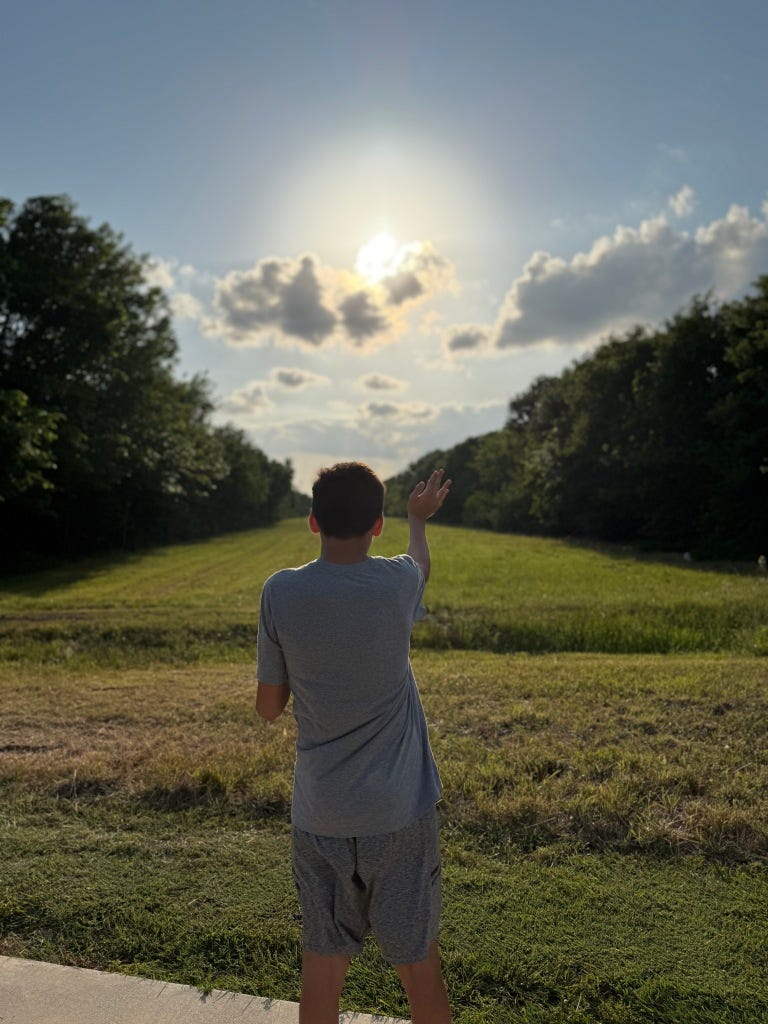
Right now, I'm taking it slow—
trying to slowly regain the control I feel like I've lost.
Yes.
I've joked with people that the Episcopal Church gave me depression.
Like most jokes, there’s at least a modicum of truth in it.
Right now, I’m only 10% joking when I say it.
But I truly believe there will come a day when only an iota of truth remains in that joke.
I trust I’ll come to a place where I’m actually grateful for this season—for the pain, for the process.
Because it’s forcing me to confront things I’ve long avoided—things that now run deeper than The Institution.
And I know I’ll be better for it. I know I’ll grow from this. I know it will continue to shape me into the person God has always intended for me to be.
I’m just not ready to say thank you yet.
But I will be.
So I move forward.
Step by step.
Day by day.
I move forward with tremendous gratitude that will hopefully, one day, outweigh the sadness.
I move forward grateful for my wife and son.
Grateful for the people in my life.
I may never have had lots of money, but I’ve always had people who loved me.
I’m grateful for the people of Mosaic Church.
I’m grateful for my bishops, the Diocese, and The Institution.
So here I am.
And here I go.
I’m in repair. I’m not together, but I’m getting there.