
ELEPHANT RHINO
3 Art Pieces that Speaks to Me

I’ve never been an art guy.
I don’t really… get it. I don’t know how to like… appreciate it like art lovers do.
I took an art class in seminary once and had to drop it because everyone else was staring at an exhibit and talking about symbolism and subtext while I was standing there thinking, “That is a cross floating in a bucket of urine.” Every time the professor asked, “What do you think the artist is trying to say,” my brain supplied one consistent answer: elephant rhino. As in, hell if I know. As in, I have no idea and why am I here?
So no, I am not the guy who walks into a gallery and starts unraveling the mysteries of the universe. Most of the time I look at art, shrug, and start thinking about the next thing on the agenda.
But there have been two pieces in my entire life that I could not walk away from.
The first is The Starry Night. I’ve talked about that before (click to read, if you want).
The second is The Great Wave off Kanagawa.
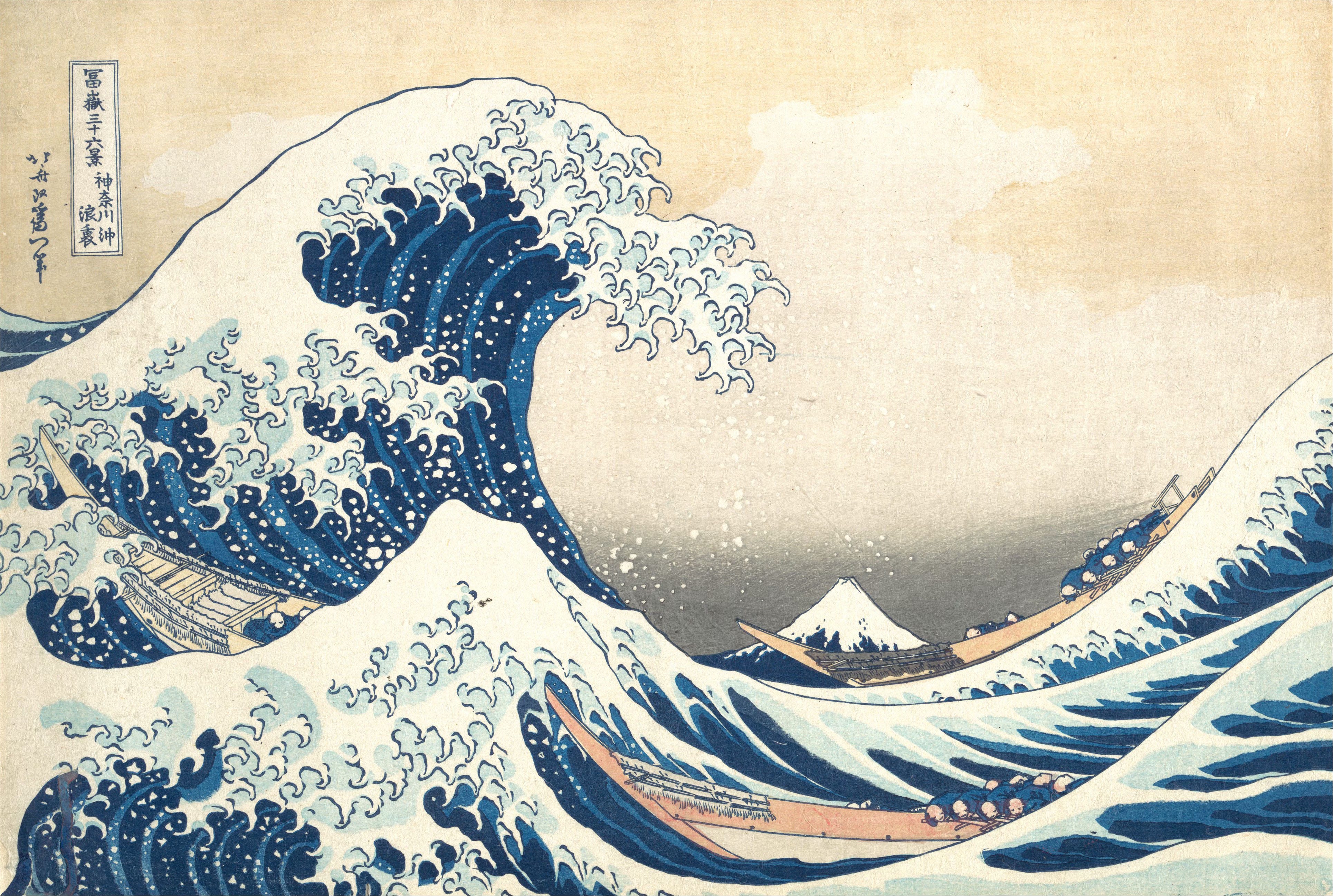
I did not choose it. It chose me. I remember seeing it for the first time, not in a museum or textbook, but on something ordinary. A print on a wall. Maybe a binder. Maybe a hoodie. I do not even remember the context. I just remember the pause. The way time slowed for a second without asking my permission.
It was not that it was beautiful, although it is.
It was that it felt true.
Most people focus on the wave because it is the dramatic part.
Huge, curling, alive, towering over everything beneath it. But the longer you look, the more you realize the wave is not the main character at all. The wave is just the world. It is the ocean that does not care who is in its way. It is the force bigger than you, indifferent to your schedule and immune to your prayers.
The real story is the boats.
Three little boats with fishermen who have no business being that close to something that big. They are not fearless. They are not conquering anything. They are not winning. But they are rowing.
There is something sacred about that.
Sometimes life hands you a moment that is not fair and not survivable and not gentle. You are not the wave. You are not Mount Fuji in the background. You are the boat in the middle, trying to hold the oars steady while everything around you threatens to swallow you whole.
And yet you row.
Not because it is guaranteed to work.
Not because you feel brave.
But because something in you refuses to give up your own life without a fight.
Being overwhelmed is not the same thing as being defeated. Fear is not failure. Survival is a miracle even if it is not glamorous.
That image stayed with me for years. But recently something inside me wanted to find a version of that feeling closer to home. Something Korean. Something that felt like memory without remembering. Something that lived in the cultural DNA beneath the surface of my life.
When I went looking for something Korean that carried the emotional weight of the Great Wave, I stumbled into minhwa (민화). And specifically, the tiger and the magpie.
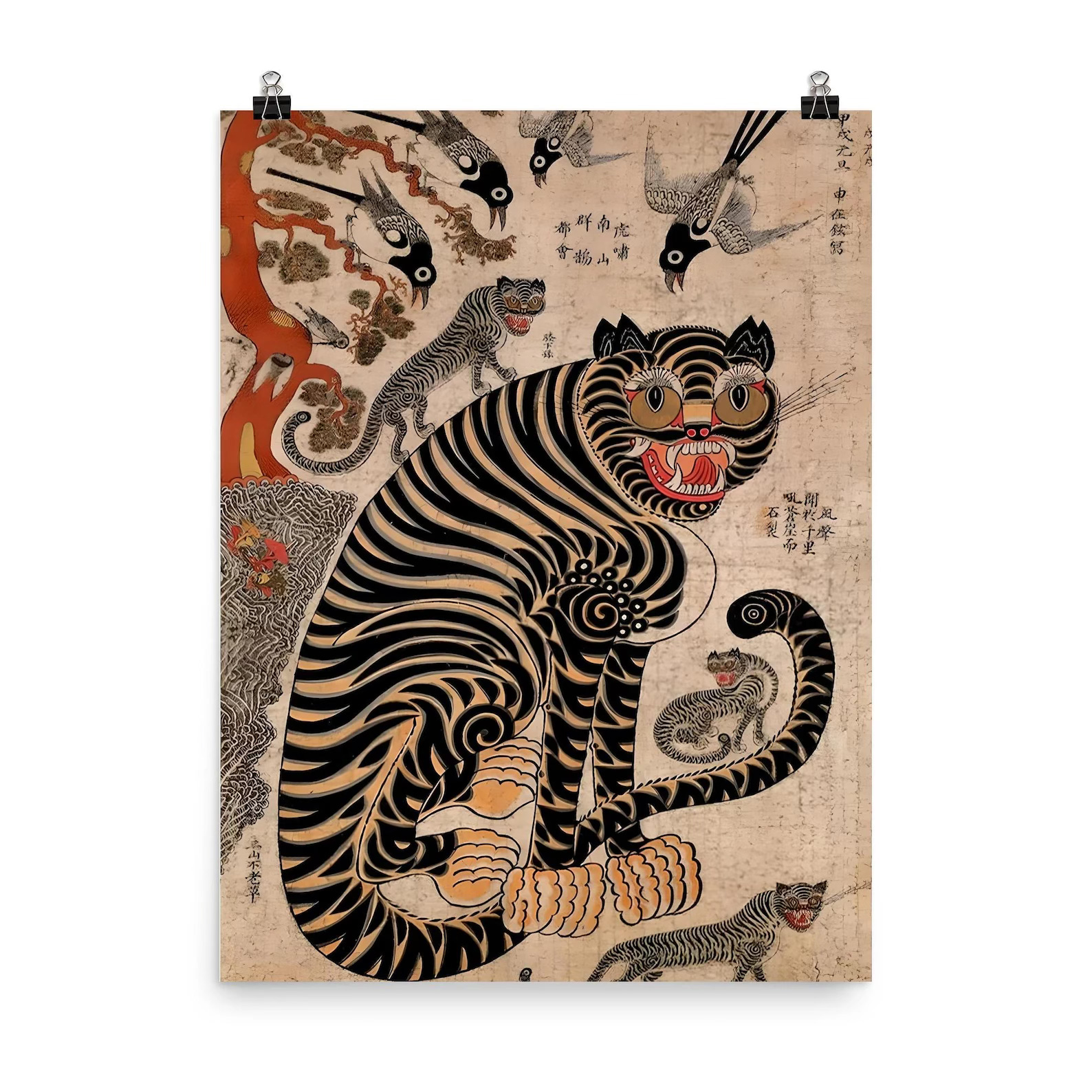
Most of you may know the tiger as Derpy Tiger from Kpop Demon Hunters.
At first glance it looks playful. The tiger’s eyes are too big. The paws are exaggerated. The mouth is dramatic. It almost feels like a cartoon. And then you notice the magpie. Small. Loud. Completely unafraid. Singing right in the face of something that by all logic should terrify it.
That is when the symbolism clicks.
In Korean folklore and folk art, the tiger represents authority. Not nature.
Authority. Officials. Landlords. Gatekeepers. The powerful.
Every person who has ever strutted around believing they deserved respect simply because they had rank.
That is why the tiger is drawn so huge.
It is force. Control. Intimidation.
It is the person who expects the room to go silent when they walk in.
And the magpie represents the people.
Not the glamorous. Not the elite. The ordinary.
The ones who keep living underneath the weight of power without losing their humor or their joy. The magpie is the song of survival. The refusal to be bullied into silence.
Here is the part that makes the painting genius. It is satire.
The tiger is terrifying in theory, but the artist intentionally paints it just a little ridiculous. Too many teeth. Too large of eyes. Too stiff in posture. It is danger, but it is also ego. The tiger is both powerful and laughable at the same time. The message is not subtle. Power thinks it is frightening, but the people see through the performance.
These paintings were not simply decoration. They were social commentary disguised as home art so that ordinary Koreans could express something forbidden. You could not publicly ridicule corrupt officials. You could not accuse the powerful of abusing their position. But you could hang a big silly-looking tiger on your wall with magpies singing in defiance and every guest who entered your home would understand exactly what sermon you were preaching.
Life can be dangerous, but joy is not negotiable.
Oppression is real, but humor keeps the human spirit alive.
Fear may win the volume contest, but hope will not shut up.
Some minhwa tigers glare at the magpie. Others look confused. Others look outright embarrassed. The subtext stays the same.
Yes, the world contains power that can hurt you. But power is not the same thing as meaning. It is not the same thing as truth. It is not the same thing as hope.
Sometimes you cannot topple the tiger.
But you can refuse to let the tiger define your joy.
That is not denial. That is resistance. It is the reminder that even if the world has claws, we still have a song. We still laugh. We still celebrate. We still raise children. We still gather around tables. We still tell stories. We still stay human when systems try to make us anything but.
There is something holy about laughing in the presence of what wants to frighten you.
Not because you are naïve.
But because you refuse to forget who you are.
Which brings me to the 달항아리 or moon jar.
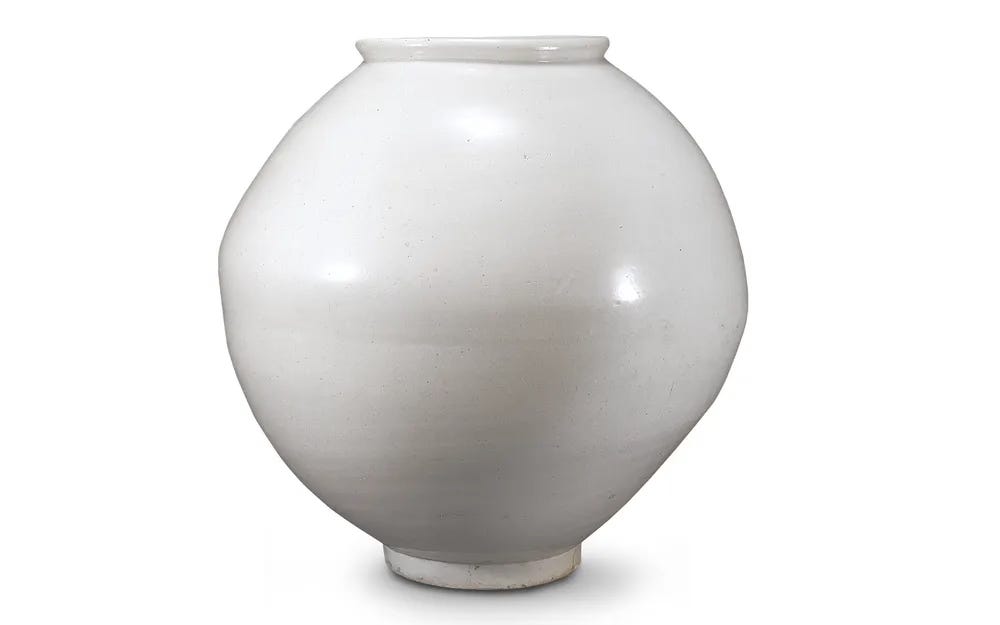
It looks so simple at first. White. Still. Quiet. The opposite of drama. It does not roar. It does not swirl. It does not confront. But it speaks just as loudly once you understand.
A moon jar is not made in one piece. It is formed from two bowls thrown separately on the wheel, then joined together to create a sphere. There is always a seam. Sometimes subtle. Sometimes obvious. The glaze is not perfectly smooth. The shape is not perfectly round. The imperfections are not mistakes. They are the point. The beauty is in the unevenness, not in sanding it away.
The moon jar has no interest in pretending it is flawless.
It is whole without being perfect.
It is quiet proof that fragility and worth can exist in the same object.
Two incomplete halves making one sacred whole.
Not because they matched exactly, but because they held.
There are seasons when I feel like the boats rowing into the wave.
There are seasons when I feel like the magpie laughing in the face of the tiger.
And there are seasons when I feel like the moon jar, just trying not to fall off the table.
None of those seasons cancel the others. All of them are human. All of them are true.
The Great Wave teaches me that being overwhelmed does not mean I have failed.
The tiger and magpie teach me that joy can be resistance and humor can be survival.
The moon jar teaches me that the things that scar me do not make me unworthy. They make me real.
Three images that carry a message for me (and you):
You are small, but not powerless.
You are afraid, but not conquered.
You are imperfect, but not broken.
You are here.
Some days you row.
Some days you laugh.
Some days you simply hold.
And every one of those is a miracle.
We do not love these images because they decorate a wall.
We love them because they tell the truth about us.
They remind us that staying alive in this world takes courage, humor, resilience, vulnerability, community, and grace.
We do not have to be flawless to be whole.
We do not have to be fearless to move forward.
We do not have to be loud to matter.
Sometimes it is enough that we are here.
Still rowing.
Still singing.
Still holding.
Still us.
Thank you, Joseph!
News Flash...you ARE an "art guy" -- whether you choose to be one or not.
Your words fully demonstrate this fact.
My experience of life is richer today because you chose to share your observations and reflections.
Thank you! ❤️
Joseph, I think that's the most beautiful, the most meaningful of your texts that I have read so far and I love many of your texts. It's a gift I needed today and I shall try to pass it on. Thank you so much.