
MEGA-MAILBAG
End of the Year Edition


Alright, friends! Here is a mega mailbag to end the year.
I didn’t start using Substack exclusively until June of 2025. I created a Substack profile at the encouragement of a friend, but for a while I would occasionally re-post my WordPress posts here. I’m glad I made the permanent move, and I’m grateful to all of you who continue to read what I share. Thank you.
And here we go with the mailbag. These are always actual comments, DMs, or emails from actual people.
I just got an invitation from you to be part of a weekly prayer gathering, but wanted to know if this was actually from you?
No. Oh goodness, no. This is for everyone. If you receive any unsolicited invitation of any sort from “me,” it’s not me. I don’t send invitations on social media. I don’t create Facebook groups. I don’t need you to like a page that some imposter created.
On both Instagram and Facebook, I’m verified, so if you receive something via those apps, check for the blue checkmark. And if you receive an unsolicited email from “me,” it is 100% fake.
I also only have ONE TikTok account, ONE Instagram account, and ONE Facebook page. Please be diligent and vigilant online.
Is there a difference between “everlasting life” in John 3:16 and “heaven” in Matthew 19:16–30, Mark 10:17–31, and Luke 18:18–30? I ask because so many people I know talk about believing in Jesus as all that’s needed for entrance to heaven, but I have the understanding that not all will dwell with Him in heaven when we die unless we give up earthly treasures.
To your question: “everlasting life” and “heaven” are related ideas, but they are not quite the same thing.
When John talks about eternal life, he’s not just talking about duration, like life that goes on forever, but about quality. It is life that begins now and is defined by relationship with God through Christ. In John’s Gospel, eternal life isn’t just a future reward. It’s a present reality that changes how we live, love, and see the world right now.
When Jesus talks about heaven, especially in the Synoptic Gospels, he’s pointing to the kingdom of heaven, which is not simply the afterlife but the reign of God breaking into this world. So when the rich young ruler asks about inheriting eternal life, Jesus redirects him toward how to live in alignment with God’s kingdom now. That often means loosening our grip on possessions, power, and pride so that love and justice can flourish.
In other words, eternal life isn’t just where we go someday. It’s who we’re becoming today. Heaven isn’t about escaping earth. It’s about God’s life taking root here and now, transforming us into people who love as Jesus loved.
How do we square the idea that a loving God sends people to hell?
Many of us were taught to picture God as loving but angry, merciful but waiting to punish. But when I look at the story of Scripture, I see a God who does not give up on us. A God who pursues, redeems, and restores. The heart of the gospel is not eternal punishment. It is relentless love.
Some Christians understand hell not as a place God sends people, but as what happens when we refuse love, a self-chosen separation. As C.S. Lewis put it, “The doors of hell are locked from the inside.”
Whatever hell is, it cannot cancel the truth that nothing can separate us from the love of God (Romans 8).
I would also recommend Hell Bent by my friend Brian Recker.
Why do you call yourself “Reverend”?
The title “Reverend” is simply part of my ordination in the Episcopal Church. It is not a claim to status or hierarchy. It simply means that I have been ordained to serve the church through preaching, teaching, and pastoral care.
An earlier meditation this week was about being childlike in the way we trust God, how little children trust adults to help them and to fix things and to teach them. But in evil? I don’t understand that. I struggle with that because we are supposed to love our enemies. And I don’t love them one bit. I believe they are evil and they need to go. And then there is the trusting God part. Maybe it is God’s plan that this country becomes completely taken over by fascists and we lose our democracy. I don’t like it, and if that is God’s plan, I am supposed to trust Him. Am I supposed to keep my mouth shut against evil? So going back to the subject verse, I just don’t understand it at all.
You’re not alone in feeling confused by that verse. When Paul says to “be infants in evil” (1 Corinthians 14:20), he is not calling us to be naïve or passive. He is talking about posture. We are called to be innocent of participating in evil, not ignorant that it exists.
In other words, do not let evil make you grow up too fast in cynicism or hatred. Be wise enough to recognize evil, but pure enough not to join in its ways.
As for loving our enemies, that is one of the hardest teachings of Jesus. Love does not mean approval or silence. Love, the way Jesus lived it, often looked like confrontation: speaking truth, protecting the vulnerable, calling out hypocrisy. But it also meant refusing to let hate have the final word.
Trusting God does not mean we sit quietly while the world burns. It means we act with integrity, courage, and compassion, even when outcomes are uncertain. God’s plan is not for evil to win. It is for goodness, mercy, and justice to take root through people who refuse to give in to fear or despair.
So no, you do not have to keep your mouth shut against evil. But you can speak and act without letting evil’s bitterness take residence in you. That, I think, is what it means to be infants in evil: keeping your heart uncorrupted, even in a corrupted world.
What are your hopes for 2026?
That the Washington Commanders build a better team and do not turn JD5 into RG3 2.0. That the LA Clippers move to Seattle and become the Supersonics 2.0. That the Houston Dynamo actually sign players who fit the system.
You do not have to give me all three. I’ll take any one.
Could you explain what [being inclusive] looks like in your place of worship, and how you came to that place of affirming LGBTQ believers?
At Mosaic, it means LGBTQ+ people are not welcomed “despite” who they are or “loved anyway,” but welcomed because they are whole, beloved image-bearers of God. It means full participation: worship, leadership, marriage, baptism, Communion. Not a different lane. Not a special policy. Not a second-tier version of Christianity.
Everyone at Mosaic receives the same invitation to follow Jesus, the same expectations of discipleship, and the same dignity.
How did I get there? Not overnight.
For a long time, I believed what I was taught and inherited. Then I started meeting and listening to LGBTQ+ Christians who loved Jesus more deeply than many church folks I knew. At some point, I had to decide whether my theology would shape my view of people, or whether the lives, faith, and fruit of actual people would send me back to Scripture to ask better questions.
What ultimately changed me was not debate. It was relationship. Once I stopped talking about “issues” and started listening to human beings, the old framework could not hold.
So for me, being affirming is not agreeing to disagree. It is repentance. Turning away from a way of thinking that caused harm and toward a way of life that reflects the radical, boundary-breaking love of Jesus.
Mosaic is not perfect. We are still learning and still trying to match our theology with our practice. But we are committed to being a church where nobody has to hide any part of who they are to belong.
What were your favorite books you read this year? I know I should be reading more. I’m not going to hit my 24-book goal for 2025.
I’m not going to hit my 24-book goal for 2025 either. But here are the books I read this year:
Daisy Jones & The Six by Taylor Jenkins Reid;
Piranesi by Susanna Clarke;
New Seeds of Contemplation by Thomas Merton;
Strong Ground by Brené Brown;
The Best Lies by David Ellis;
Vera, or Faith by Gary Shteyngart;
Storyworthy by Matthew Dicks;
Britt-Marie Was Here by Fredrik Backman;
The Night Circus by Erin Morgenstern;
Better Ways to Read the Bible by Zach Lambert;
Blankets by Craig Thompson;
Remarkably Bright Creatures by Shelby Van Pelt;
James by Percival Everett;
The Tears of Things by Richard Rohr;
The Wedding People by Alison Espach;
Welcome to the Hyunam-Dong Bookshop by Hwang Bo-Reum;
Love Matters More by Jared Byas.
Currently, I’m listening to Brandon Sanderson’s Tress of the Emerald Sea; reading Kim Ji-Young, Born 1982 by Cho Nam-Ju; Hell Bent by Brian Recker; and a bunch of books on Job because I think I want to do our Lenten study on Job.
Is this a characteristic of ADHD? I am fracking determined to finish the current reads.
As for favorites: work-wise, New Seeds of Contemplation was my first Thomas Merton book, and I got a lot out of it.
Recreational-wise: My mind keeps going back to Britt-Marie Was Here and Remarkably Bright Creatures. I’m jealous that this was Shelby Van Pelt’s debut novel, and even more jealous of how she made the octopus my favorite character.
Fredrik Backman is one of my favorite authors. I have The Friends queued up on Audible. I’m not a big fan of series, but I read Beartown years ago and learned this year that it ended up being a trilogy. So I have those books lined up as well.
But there’s so much TV to watch too.
So, what makes a Progressive Christian? I’ve always thought the term was “code” for Liberal Christianity.
For me, it’s about taking Jesus seriously, loving God and neighbor, fighting for justice, and trusting that grace really is big enough for all of us.
At its best, Progressive Christianity isn’t about ditching belief in the supernatural or turning God into a metaphor. It’s about honest faith, asking good questions, holding on to mystery, and refusing to use God as a weapon.
If you want to read more in that spirit, I’d recommend Faith After Doubt by Brian McLaren or Searching for Sunday by Rachel Held Evans.
Hi, we work with local businesses that want laundry to run smoothly. Can I share some info on how it’s working for others in the area?
No, thank you.
Have you seen The Chosen?
No. And I’ve heard it’s really good. Buuuuuuuut I want to watch TV to escape church thoughts. I’ll stick to the book, if y’all don’t mind.
What is the best and worst thing about being a pastor?
The best thing about ministry is the people. When people truly practice and embody the teachings of Jesus, no earthly power has a chance of stopping us.
What’s the worst thing about ministry? People.
Sometimes the same person can be the best and worst part of being a minister, depending on the season. Or the week.
Can an atheist come to your church?
Yes. Absolutely. Why not?
As long as you don’t mind a little bit, or truthfully a lot, of Jesus talk. There are no prerequisites to attending church, particularly ours. If you’re looking for community, there are lots of great people to connect with. We’ll hold space for you however you may need it.
What do you wish church people would know more about pastors?
Please understand that we are not mind-readers. Even the strongest prayers don’t give us that ability.
Sometimes we don’t know that you’re ailing because you’ve never told us. We didn’t know you were in the hospital because you didn’t tell a single soul. Sometimes word of mouth doesn’t travel that fast, unless it’s tea.
Even if you tell your closest church friend about your upcoming surgery, that does not guarantee the information will get to us.
You wouldn’t believe how many times people got upset with me for things I didn’t know were happening.
True story. Once, I called a church member just to check in because I hadn’t seen her for about three Sundays, which was unusual since she attended every week. When I told her it was me, she responded, “Thank you for calling. I really felt like the church didn’t care about me these past few weeks. I had surgery and nobody from the church asked how I was doing.”
I apologized and asked, “Did you let anyone know you were getting surgery?”
“Well, no. I didn’t get a chance to tell anyone.”
I felt a nudge in my heart not to ask the question that was on everyone’s mind: “How were we supposed to know, then?”
Instead, I simply apologized and asked if I could come visit her within the week. She accepted, and I visited her a few days later.
So please, please let us know when something’s not right. You’re not bothering us. You’re not burdening us. We are here to help the best way we can.
This one’s not that important, but it was the first thing that popped into my mind.
Who’s your favorite disciple?
Peter.
How do you have a wife and a child?
Not Catholic.
What’s your favorite Gospel?
Luke.
Who’s your favorite superhero?
The most favorite? Spider-Man, probably.
How long have you worked at a church?
Since 1999.
What’s your denomination?
The Episcopal Church. I was previously United Methodist and will always be Wesleyan at heart.
What’s your nationality?
Nationality? I’m a U.S. citizen. But I feel like you’re asking about my ethnicity, which is Korean.
Why do you still watch wrestling? It’s fake.
Why don’t you watch wrestling? I would like to see you do a swanton dive onto thin plywood and tell me it’s fake.
It’s scripted. There’s a difference. Think of it as a reality show, but with actual talent. Unlike no-talent reality shows like Keeping Up with the Oversaturated K People, Vanderpump Rules, or Real Housewives.
Also, end of an era with Cena’s last match on 12/13.
Do you believe in Ghosts?
I… well… I mean, at least one right? The Holy one…?
I just saw a video about your “Impact Offering.” What is that about?
The video explained what our Impact Offering is about………………… (this is the same feeling when someone from church comes up to you and says, “Well I’ve never heard about this” and you just want gently and lovingly want to put them in un-suffocating chokehold them in the powerful name of Jesus because it’s been in the announcements for 3 weeks!!!!!!!!!!!!) *ahem*. Anyhoo.
Christmas Eve is still one of the most highly attended services for churches. Many churches take that opportunity to help with their budget, and there’s nothing wrong with that.
I served at a church that chose not to do an Impact Offering because leadership wanted the offerings to stay in-house. As an associate, I had no say, but I understood. What they were doing is not wrong. And what we’re doing isn’t the right way.
I got the idea from Michael Slaughter, who was the first person I heard say, “Christmas isn’t your birthday.” They called theirs a Miracle Offering.
Instead of taking money to help with our budget, we collect an offering and donate 100 percent of it. Every single cent. None of it is kept by us.
We give it to a local nonprofit because I genuinely believe this is the best way for a church to celebrate Christmas.
Circling back, to answer the question for real:
What are your hopes for 2026?
I hope my church and I can continue to be a source of hope and love in our community. I hope more followers of Jesus gain the boldness to lean into sacrificial love and start providing healing to our communities instead of worshiping power.
I hope Korea makes a deep run in the World Cup, and that the World Cup doesn’t destroy Houston. This city is going to get packed.
I hope for the health of my parents and my parents-in-law. Just health all around.
I hope for more wisdom and maturity as we head into year four of this church plant. Wait. Year five? We just turned 4… so this is year 4 right? I don’t know. Listen, this is why you can’t rely on stereotypes all the time.
I’m tall.
I’m bad at math.
I also hope for courage to be even bolder in love, however that may manifest. I hope my wife gets everything she deserves and works for. And I hope I always remember to put people before institutions.
I hope that I will always lean into gratitude first and foremost.
… To name a few.
Now let’s get to the folks who have blessed hearts…
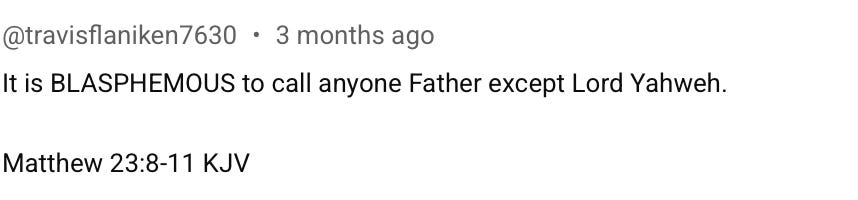
Anyone who comes back at me with a KJV is not worth my time to respond, and I have no desire to elaborate on that. Just a caveat. The KJV is among the least reliable translations by modern scholarly standards. Fun fact: King James himself was queer. It always tickles me when people use the KJV to justify homophobia.

Still able to see. Granted, my eyes aren’t what they used to be in my twenties, but that’s not because of your silly prayer. It’s what happens when someone is in their mid-forties. The phrase “no hate like Christian love” comes to mind here.
For context, this person was offended that we dare include our LGBTQ siblings in the work of bringing God’s kin(g)dom closer to earth.

Discernment bells, lol. Maybe that means you should discern more than pray for my eyes to open. Also, why did you capitalize the “H” in His when referring to me?
Homophobia is rampant in far too many churches.
And finally, I seem to have earned a new stan:
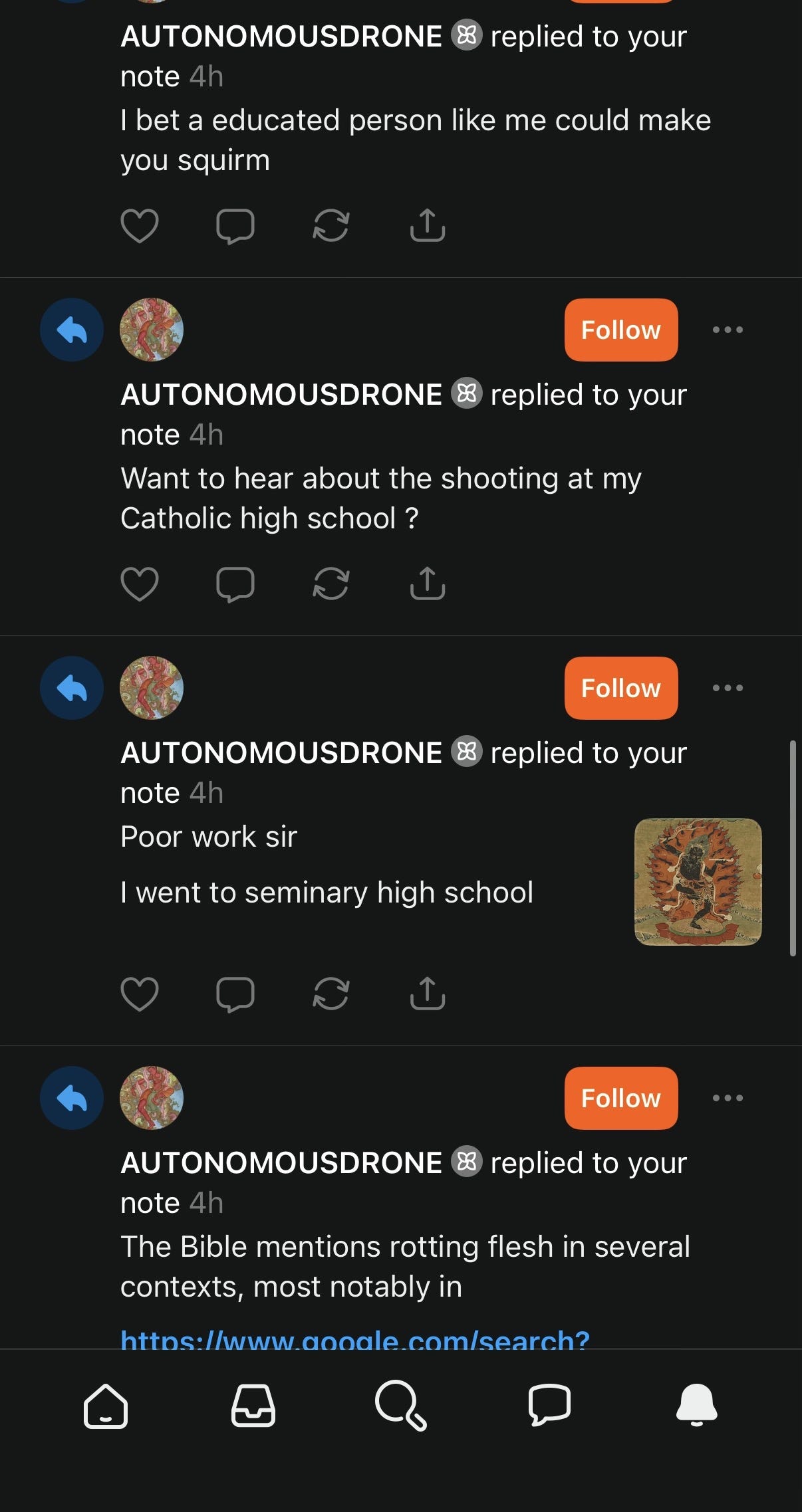
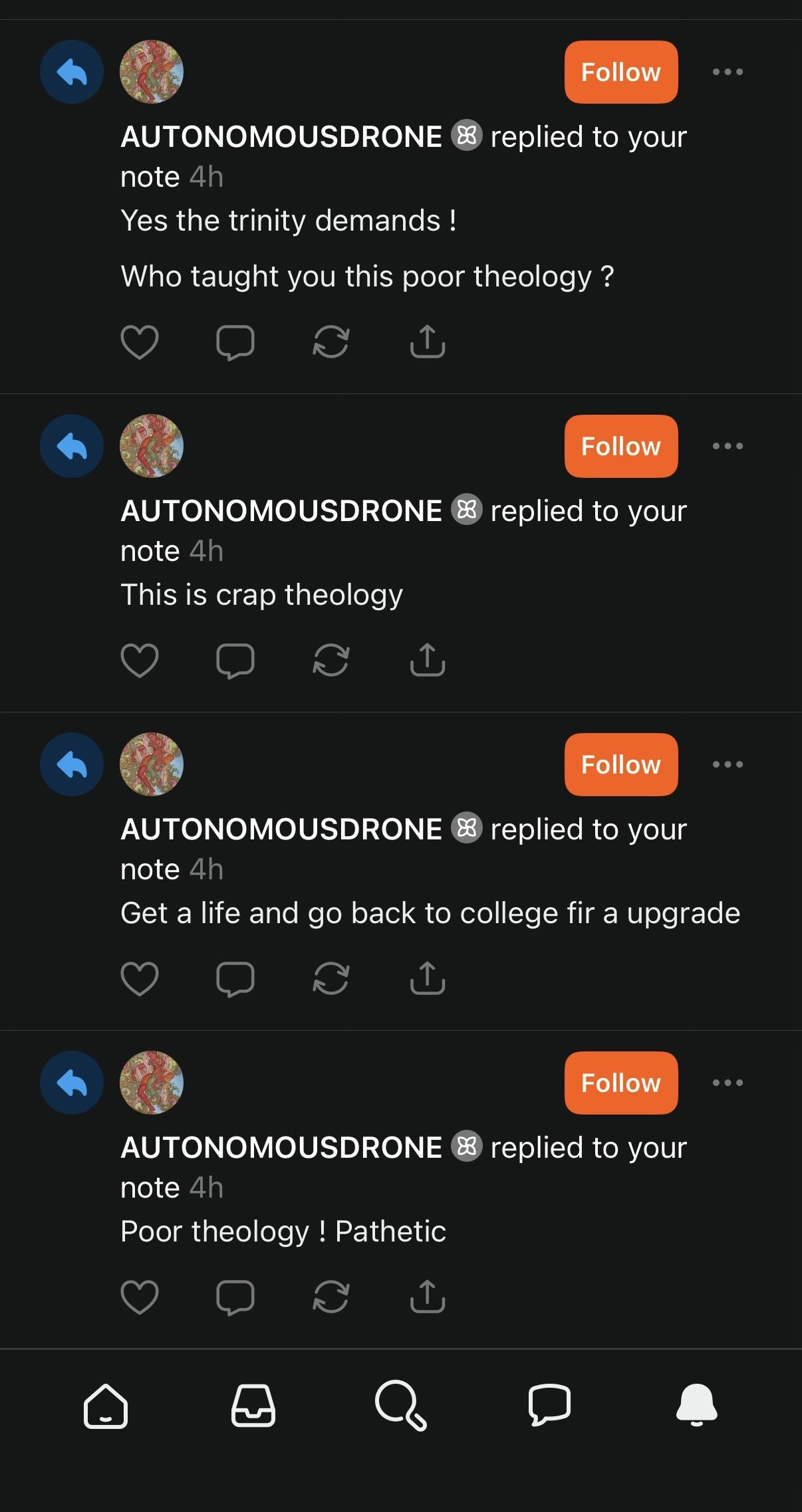
It’s always funny when people who spam comments have the gall to say, “Get a life.”
Friend, you spammed over eight comments in less than an hour. To the point that I couldn’t keep up, nor did I want to screenshot all of them.
Go touch grass. Know that God isn’t done with you yet.
But I sure as hell am. 😉
Merry Christmas and a Happy New Year, everyone!
You are one of the treasures I discovered this year and I am so grateful for that! You combine humour and depth and so give me the chance to really listen, which otherwise I wouldn't want and wouldn't do. I'd love to come to your church and see Mosaic in action- it's a pity, that will not happen as long as...King Herod...reigns in the USA.
Have a lovely Christmas with your lovely family!
As usual, your posts offer good "food" for me as a pastor. I appreciate your levity, but also your honesty and loyalty to what it is we try to accomplish on a weekly basis. I especially loved the post about what pastors hope for from our flocks. Communicate! Don't assume. Wish you and your family a wonderful Christmas and all of us a safe, happy, and healthy new year. Blessings!